
Pulsetto is one of the best-known neck-worn vagus nerve stimulators, and the Pulsetto vagus nerve stimulator now comes in three versions: Lite, FIT and the newer FIT X. They look similar on paper, so this Pulsetto review for 2026 is a calm, plain-English comparison to help you work out which one (if any) fits your routine and budget. Along the way we answer the questions people search for most: does Pulsetto work, what are the side effects, how do you use it, and is it worth it? We read through Pulsetto’s product, safety and help pages and we only state what those pages say, flagging anything that doesn’t add up.
Check the current Pulsetto price →
What is Pulsetto?
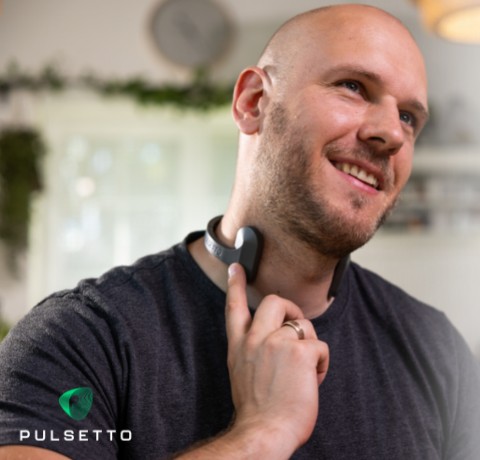
Pulsetto is a small, hands-free device that you wear around your neck. Pulsetto describes it as a general wellness product that delivers gentle electrical stimulation through contact points on the neck, controlled from a phone app. You spread a little conductive gel on the contact points, put the device on, choose a program in the app and sit back. Sessions are short: Pulsetto’s stress, focus and release programs run for about 4 minutes, and its sleep program is about 10 minutes, ideally started around 30 minutes before bed.
Pulsetto is clear that it is not a medical device and is not intended to diagnose, treat, cure or prevent any condition. It is made in Lithuania, and Pulsetto states that it is FCC certified. We should also be upfront about the evidence: Pulsetto highlights results from a small pilot study of 40 people and itself notes that the data is exploratory, with no placebo control. We have not independently reviewed that study, so we have left the percentages out and suggest treating them as the brand’s own early findings.
A word on Pulsetto reviews, too. Pulsetto’s own site shows a rating of around 4.4 to 4.5 out of 5 from 20,137+ customers, and it labels the customer stories as individual experiences rather than typical results. Those are the brand’s figures, and we have not seen independent testing, so please read any Pulsetto reviews online (including this one) with that in mind.
If you are new to the topic, our vagus nerve hub explains the basics, and our guide to vagus nerve exercises at home covers free techniques you can try alongside, or instead of, a device.
Pulsetto Lite vs FIT vs FIT X: side by side
Everything below comes from Pulsetto’s own pages. Where two pages disagree, we say so.
| Feature | Pulsetto Lite | Pulsetto FIT | Pulsetto FIT X |
|---|---|---|---|
| Price on 12 Oct 2026 (USD, sale price) | $269 | $296 | $350 |
| Brand’s positioning | “Best for most users” | “Comfort and battery” | “Most capable” (new flagship) |
| Worn on the neck, hands-free | Yes | Yes | Yes |
| Battery life (per Pulsetto’s comparison table) | 7 days | 10 days | Up to 12 days |
| Expert programs | 3 | 5 | 5+ |
| Offline mode | Not included | Included | Included |
| Lifetime firmware updates | Not included | Included | Included |
| Fits different neck sizes | Not included | Included | Included |
| Adaptive stimulation (auto-adjusts intensity) | No | No | Yes |
| Contact sensing | No | No | Yes |
| Vibration feedback on the device | No | No | Yes |
| In the box | Device, 60 g gel tube (described as about a 30-day supply), USB-C cable, user manual | ||
| App and trial | Free iOS/Android app with 5 programs; free Premium trial included | ||
| Warranty and returns | 2-year warranty (optional 2-year extension); 30-day money-back guarantee | ||
Prices are the sale prices shown on Pulsetto’s US store on 12 October 2026, during its Autumn Sale (“up to $250 off”). The EU store listed the Lite at €269 and the FIT at €296 on the same day.
Pulsetto Lite: the budget option
The Lite is the entry point, and Pulsetto calls it the best choice for most users. It has the same core hands-free neck design and the same app. In exchange for the lower price you get a shorter listed battery life (7 days), fewer expert programs (3 in the comparison table), and no offline mode or lifetime firmware updates. Pulsetto’s FAQ positions it as a more basic option for larger neck sizes, while its table lists “fits different neck sizes” as not included, so it appears to be a one-size design.
Pros
- Lowest price of the three
- Same core design, app and 30-day guarantee as the others
- Simple, with fewer features to think about
Cons
- Shortest battery life and no offline mode
- Appears to be one size
- Pulsetto’s own pages disagree on how many programs it has
- Only $27 less than the FIT at the sale prices we saw
Check the current Lite price →
Pulsetto FIT: the best all-rounder
The FIT keeps the Lite’s core design and adds comfort and convenience: a longer battery (10 days), five expert programs, an offline mode, lifetime firmware updates and a design built to suit different neck sizes. Pulsetto’s guidance is that if you usually wear a size small or smaller, the FIT is the one to pick, because it is built for slimmer necks; it adds that the FIT also works for larger sizes.
Pros
- Designed for different neck sizes, with ergonomic padding
- Longer battery than the Lite, plus an offline mode
- Lifetime firmware updates
- Small price step up from the Lite
Cons
- No adaptive stimulation or contact sensing (those are FIT X features)
- Regular price listed differently on two Pulsetto pages ($496 and $546)
- Still needs the app and a fresh layer of gel for each session
Pulsetto FIT X: the new flagship
The FIT X is Pulsetto’s newest model. On top of everything the FIT offers, it lists adaptive stimulation (which Pulsetto says adjusts intensity for you in real time), contact sensing that checks placement before and during a session, gentle vibration cues on the device, a glowing ring that shows when a session is active, and redesigned electrodes that Pulsetto says are rated for 30,000+ sessions. Its battery is listed at up to 12 days.
Pros
- Longest battery life listed
- Contact sensing and vibration feedback may reassure first-timers who worry about placement
- Adaptive stimulation and 5+ programs
- Everything the FIT has
Cons
- Highest price: $54 more than the FIT
- The extra features are the brand’s descriptions, and we have not tested them
- Newest model, so there is less user feedback available
Check the current FIT X price →
The app, the gel and other extras

- 📱The app is required. You need the Pulsetto app to connect the device, pick a program and start a session. It is free and includes 5 programs (sleep, stress, calm, focus and release), plus wearable connections to Apple Health, Garmin, Whoop and Oura. A free trial of Premium comes with each device.
- ⭐Premium is optional. Premium adds extra programs (recovery, gut, head and personal), a daily personalised protocol, a stress resilience score, guided breathing and an AI chat. Pulsetto says you can cancel any time and that you do not need Premium to use the device. We found different prices on different pages (a 12-month plan at €129 on the EU store; a $15 listing in the US cart), so check the price before your trial ends.
- 🧴Gel is a consumable. You apply conductive gel to the contact points each session. One 60 g tube comes in the box, and Pulsetto describes it as a roughly 30-day supply. Refills are sold as a “Gel Box” of four 60 g tubes that auto-renews every 3 months (you can skip or cancel). We could not find its price, so factor in this ongoing cost.
- 🧳Travel cases and cleaning wipes are also sold. They are optional extras, so skip them unless you plan to travel with the device.
How to use Pulsetto: what to expect in a session
- 🔌Set up. Turn the device on, open the app and tap to connect.
- 🧴Apply gel. Put a generous amount on the contact points, then place the device on your neck.
- 📈Start low. Pulsetto recommends starting at the lowest intensity and slowly raising it until you feel a light tingling in the neck area.
- 💪Expect some twitching. Pulsetto says you will likely feel muscle contractions where the device sits, that these are normal, and that they stop when the stimulation ends.
- 🌙Sleep program. Pulsetto suggests 10 minutes about 30 minutes before bed, and recommends dimming screens and using warm lighting. You can pair a session with slow breathwork if you like.
Pulsetto’s pilot study used the device twice a day for 4 weeks, but the brand does not set one universal schedule on the pages we read. Follow the user manual and the app, and speak to your doctor about what is right for you.
Pulsetto for sleep
Sleep is the main reason many people look at a device like this. Pulsetto has a dedicated sleep program in the free app, which it describes as about 10 minutes, ideally started roughly 30 minutes before bed as part of a regular wind-down routine. Its own tips are to dim your screen and use warm lighting during the session. We would treat it as one part of an evening routine rather than a quick fix: slow breathwork or a calmer evening light set-up (see our guide to red light therapy and the nervous system) fit naturally alongside it. If sleep problems are persistent, it is worth talking to your doctor rather than relying on a gadget.
Pulsetto side effects and safety
We did not find a formal list of side effects on the Pulsetto pages we read. What Pulsetto does describe is a light tingling in the neck and some muscle contractions where the device sits, which it says are normal and stop when stimulation ends. It also advises starting at the lowest intensity and raising it slowly. Because the device sends electrical stimulation through the neck, the safety list below matters more than a generic “check with your doctor” line. If anything feels uncomfortable or worrying, stop using it and speak to a healthcare professional.
Safety: who should not use Pulsetto
Pulsetto is a general wellness product, not a medical device, and it is not intended to diagnose, treat, cure or prevent any condition. Pulsetto’s own safety page lists these contraindications: an active implanted medical device such as a pacemaker or hearing-aid implant; a metal implant such as a stent, plate or screw at or near the neck; and using another device (for example a TENS unit or muscle stimulator) or a portable electronic device at the same time.
It also says its safety and effectiveness have not been evaluated in people with uncontrolled high or low blood pressure, a slow or fast heart rate, a history of heart disease, abnormal ECG or arrhythmia, a cut vagus nerve, children, pregnant women, active cancer or cancer in remission, abnormal neck anatomy, a history of brain tumour, aneurysm, bleed or head trauma, fainting or seizures, or nickel allergy. If any of this applies to you, or you are unsure, please talk to your doctor before using it.
Does Pulsetto work?
That depends on what you mean by “work”, and no honest source can promise you a result. Pulsetto’s own evidence is a pilot study of 40 people that the brand itself calls exploratory, with no placebo control, so it cannot tell us how much of any change came from the device, from the routine or from simply expecting to feel better. Pulsetto also says results vary and are not guaranteed. Customer stories on its site describe calmer evenings and better sleep, but again, these are individual experiences. A fair way to find out for yourself is to use it consistently as the app guides you, jot down your sleep and stress for a few weeks, and use the 30-day return window if it does not suit you.
Pulsetto vs Nurosym, Vagustim and Sensate
If you are weighing up Pulsetto against other vagus nerve devices, the main differences are where they sit on your body, how they work and whether an app is required. We added Nurosym, a frequent “Pulsetto vs Nurosym” search, based on what its own website says; we have not reviewed it separately.
| Device | Where it is worn | How it works | Our guide |
|---|---|---|---|
| Pulsetto (Lite, FIT, FIT X) | Neck, hands-free | Gentle electrical stimulation, run from the app | This page |
| Nurosym | Ear (clips on; its site says the left tragus) | Electrical impulses; its site says no app or paid subscription is needed and calls it a certified medical device | Not reviewed on this site |
| Vagustim (V2, V2 Plus) | Ear (earsets) | Gentle electrical pulses; app optional, with buttons on the device | Vagustim V2 vs V2 Plus |
| Sensate | Chest (sternum) | Low-frequency vibration with a sound track, and no electrical current | Sensate review |
In the Pulsetto vs Nurosym question, the practical differences are placement (neck or ear), the app (Pulsetto needs it, while Nurosym says it does not), session length (Pulsetto’s programs run about 4 to 10 minutes, while Nurosym’s site suggests 30 to 60 minutes a day) and regulatory wording: Pulsetto says it is a wellness product and not a medical device, while Nurosym describes itself as a certified medical device. We have not verified either claim, and we did not compare Nurosym’s price. Each brand argues for its own placement, and we have not seen independent head-to-head testing, so we would not call either one better. If you prefer to avoid electrical stimulation altogether, Sensate is the non-electric option. If you would rather not wear something on your neck, the ear-based Vagustim is the alternative. None of them is “best” for everyone; it depends on your comfort, your health situation and your routine.
Is Pulsetto worth it?
At the sale prices we saw ($269, $296 and $350), Pulsetto sits in the middle of the range for vagus nerve devices, but the sticker price is not the whole cost. Gel is a recurring expense (the refill box auto-renews every three months and we could not find its price), Premium is an optional subscription, and although there is a 30-day money-back guarantee, you pay for the return label ($5 to $35) and shipping fees are not refunded. It may be worth it if you like the idea of a short, structured routine, you are comfortable with electrical stimulation on the neck, and nothing on the safety list applies to you. It is probably not for you if you want a non-electric option, dislike wearing something on your neck, or would rather not depend on an app.
Which one should you choose?
Our verdict
If you are a beginner: choose the FIT. For about $27 more than the Lite it adds an offline mode, a longer battery and a design for different neck sizes. If you are nervous about placement, the FIT X’s contact sensing may help, though it costs $54 more again.
If you are on a budget: the Lite is the cheapest way in. Be aware that it has the shortest battery, no offline mode and fewer programs, and that the gap to the FIT is small.
If you plan to use it often: the FIT X has the longest listed battery life and the most features, and the FIT is the sensible middle ground. Remember to budget for gel refills.
If you want to avoid the neck or electrical stimulation: look at the ear-based Vagustim or the non-electric Sensate instead.
See Pulsetto’s current prices →
Frequently asked questions
What is Pulsetto and how does it work?
Pulsetto is a hands-free, neck-worn vagus nerve stimulator for general wellness. You apply a little conductive gel, place it on your neck and start a program in the free Pulsetto app, which controls gentle electrical stimulation. It comes in three versions: Lite, FIT and FIT X. Pulsetto says it is not a medical device.
Does Pulsetto really work for stress and anxiety?
Nobody can promise results. The Pulsetto app includes stress and anxiety programs, but Pulsetto’s evidence is a small pilot study of 40 people with no placebo control, and it says results vary and are not guaranteed. It is a wellness tool, not a treatment for anxiety, so speak to your doctor if anxiety is persistent.
Can Pulsetto help improve sleep quality?
Pulsetto has a sleep program of about 10 minutes, ideally started around 30 minutes before bed as part of a wind-down routine. It may support a calmer evening, but the evidence is early and individual responses vary. Using Pulsetto for sleep works best alongside good sleep habits.
What are the side effects of using Pulsetto?
We did not find a formal list of Pulsetto side effects. Pulsetto describes a light tingling and some muscle contractions in the neck during sessions as normal, and advises starting at the lowest intensity. Its contraindications include pacemakers and other implants, pregnancy, heart conditions and seizures. Stop and see a doctor if anything worries you.
Is Pulsetto safe to use every day?
Pulsetto states that it is FCC certified and made for general wellness use, but we did not find one fixed daily schedule on its pages. Its pilot study used twice-daily sessions for four weeks. Follow the manual and app guidance, check the contraindications, and ask your doctor before daily use, especially if you have a heart condition.
How much does Pulsetto cost, including the app subscription?
On 12 October 2026, Pulsetto’s sale prices were $269 (Lite), $296 (FIT) and $350 (FIT X). The Pulsetto app is free with 5 programs and a Premium trial; Premium is optional and can be cancelled, but its price varies by store, so check before the trial ends. Gel refills are a separate recurring cost. There is a 30-day money-back guarantee.
How do you use Pulsetto for vagus nerve stimulation?
Turn it on and connect it to the app, apply gel to the contact points, place the device on your neck and choose a program. Start at the lowest intensity and raise it slowly until you feel a light tingling. Stress, focus and release programs run about 4 minutes, and the sleep program about 10. Follow the user manual.
Pulsetto vs. Nurosym: Which vagus nerve stimulator is better?
Neither is better for everyone. Pulsetto is worn on the neck and runs from an app, while Nurosym clips to the ear and, per its site, needs no app or paid subscription. Both use electrical stimulation. Each brand argues for its own placement, and we have not seen independent head-to-head testing.
Where to go next
If you are still working out whether a device is the right step, start with the signs your nervous system is dysregulated, and explore the vagus nerve hub.
This article is for educational purposes only and is not medical advice. Please speak to your doctor before using any stimulation device, especially if you are pregnant, have an implant, a heart condition or epilepsy.